You upload a photo to find out if it's AI-generated. One tool flashes "Content Credentials found," another reports "SynthID detected," and a third shows you nothing at all. So which one is right, and why does the same image produce three different answers to the same question? That gap is exactly why people end up searching C2PA vs SynthID in the first place. The honest answer: these are two different systems that prove two different things, and once you see how each one works, the confusion clears up for good.
What C2PA and Content Credentials Actually Are
Start here, because the names trip everyone up. C2PA is an open technical standard for recording where a piece of media came from and how it changed along the way. Content Credentials is simply the friendly, consumer-facing name for that same technology. If you've seen a small "CR" badge on an image or the phrase "digital nutrition label," that's this.
The standard comes from the Coalition for Content Provenance and Authenticity, launched in 2021 by Adobe, Microsoft, the BBC, Intel, Arm, Truepic, and Sony, and now housed under the Linux Foundation. Under the hood, a compatible camera or app writes a small signed record, called a manifest, directly into the file. That record can log the capture device, the editing software, timestamps, sometimes the location, and whether AI had a hand in it.
The signing part is what makes it trustworthy. C2PA uses the same kind of certificates that secure banking sites over HTTPS, so if anyone alters the image or the record after it's signed, the seal visibly breaks. The current version of the specification is C2PA 2.4. Picture a signed logbook that travels with the photo: it doesn't promise the story inside is true, only that nobody tampered with it after signing.
How SynthID Works, and Why It's So Different
SynthID takes the opposite approach. It's Google DeepMind's invisible watermark, and instead of attaching a note to the file, it nudges the content itself. During generation, it makes tiny adjustments to pixel values (or audio samples, or word choices) in a pattern a matching detector can read back later, with no visible change to human eyes.
Two neural networks do the work: one embeds the pattern as the content is created, and a second one scans for it afterward. SynthID covers four media types across Google's models: images from Imagen, video from Veo, audio from Lyria, and text from Gemini. Because the mark lives in the pixels, it's built to survive cropping, compression, filters, rotation, and even a screenshot, the exact things that erase every other clue about where a picture came from.
It has also spread beyond Google. Since May 2026, images made with ChatGPT carry a SynthID watermark too, after OpenAI agreed to embed it, and NVIDIA's Cosmos model uses it as well. The scale is the part most people underestimate.
C2PA vs SynthID: The One Difference That Changes Everything
If you remember one thing from this whole post, make it this: C2PA lives in the metadata, and SynthID lives in the pixels. Almost every practical difference between them falls out of that single fact.
Metadata sits in the file's container, in a tidy box alongside the image data. It's rich and detailed, but it's also easy to remove. Take a screenshot and you create a brand-new file with none of the original manifest, so the Content Credential is simply gone. The pixels, though, get copied faithfully, which means a SynthID watermark rides along in that screenshot completely intact.
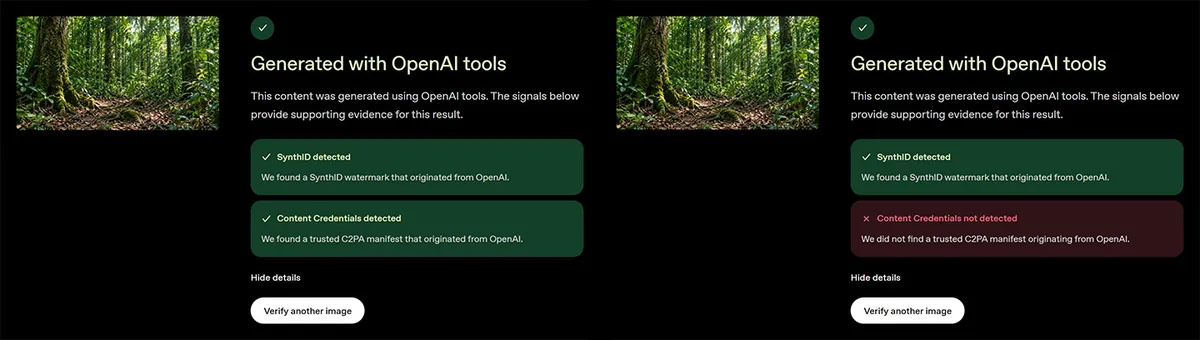
A screenshot erases a Content Credential and leaves a SynthID watermark untouched. That one fact explains almost everything about how the two differ.
So the trade is clean. C2PA carries a deep, detailed history but is fragile in the wild. SynthID carries almost no detail but is durable enough to survive the messy way images travel online. Neither is better. They're solving different halves of the same problem.
What Each One Can and Can't Tell You
Here's where the difference gets practical. A valid C2PA manifest can show you the tool that made the image, the software that edited it, when it happened, and sometimes who published it. What it can't do is judge whether that story is true. It only confirms the record is properly signed and untouched, and it only helps if the manifest survived the trip and the signing certificate is one your checker recognizes.
SynthID answers a narrower question: was this made or edited by a participating AI tool? A hit can even flag that only part of an image was generated. But it won't name the exact model, it won't give you an edit history, and it goes silent for any tool that never implemented the watermark, which is still most AI generators in 2026. This is also why a quick metadata-and-ELA scan is a smart first move before you trust or dismiss any single badge: it shows you what's really embedded in the file and whether the pixels themselves show signs of editing.
The Result Almost Everyone Reads Backwards
Here's the mistake I run into more than any other: people see "no Content Credentials" or "no SynthID watermark" and conclude the image must be real. That's reading the result backwards, and it will steer you wrong.
A blank result has plenty of innocent explanations. The platform stripped the metadata on upload, an export tool dropped it, or a screenshot wiped it clean. The image might come from an AI tool that never watermarks anything. Or heavy editing may have degraded the mark past the point of detection. A positive hit is meaningful. A negative is close to silent.
A watermark hit tells you something. A miss tells you almost nothing. Read it the other way around and you'll end up trusting the wrong images.
Why the Smartest Move Is Using Both
The two systems were never really rivals, and the biggest players have stopped treating them that way. The pattern is simple: use rich metadata for context, and an invisible watermark for durability. Each one covers exactly where the other is weak.
This stopped being theoretical on May 19, 2026. That day, OpenAI joined the C2PA steering committee and began embedding SynthID watermarks alongside the Content Credentials it already writes into ChatGPT images. On the same day, at its I/O event, Google announced that both C2PA verification and SynthID detection are coming natively to Search and Chrome. Two of the largest AI labs landed on the identical dual-layer answer, independently, on the same afternoon.
Regulation is pushing the same direction. The EU AI Act's transparency rules, enforceable from August 2026, expect AI-generated content to be marked in a machine-readable way, and a layered approach is the most reliable way to meet that bar. The takeaway for you is calmer than the headlines: when an image carries both signals, you get the full story and a mark that survives sharing. When it carries neither, you've learned nothing yet.
How to Check an Image in Under a Minute
You don't need special software to get started. Two free checks cover most everyday situations, and together they take about a minute.
For Content Credentials, upload the original file to the official verify page at contentcredentials.org. If a signed manifest exists, you'll see the history laid out: the tool, the edits, the origin. For SynthID, open the Gemini app, upload the image, and ask whether it was created or edited by Google AI; it will tell you if it finds a watermark, and even flag when only part of the image is marked. Google's standalone SynthID Detector portal exists too, but access is still limited to a waitlist for journalists and researchers, and OpenAI runs a separate preview that checks images from its own tools.
Quick check
Upload the original file (not a screenshot) to contentcredentials.org to read any C2PA history.
Ask the Gemini app whether the image was made or edited by Google AI to check for a SynthID watermark.
Run the file through a metadata and Error Level Analysis scan to see what's embedded and whether the pixels show editing.
That third step matters because provenance signals only tell you part of the story. A file can arrive with no credentials at all and still be a plain, untouched photo, or it can look clean while the pixels quietly show where an edit happened. Combining provenance with forensic checks is how you avoid both false alarms and false comfort.
FAQ
Is C2PA the same thing as Content Credentials?
Can a SynthID watermark be removed?
If an image has no Content Credentials and no watermark, is it real?
Which should I trust more, C2PA or SynthID?
The Bottom Line
The difference between C2PA and SynthID comes down to two words: metadata and pixels. C2PA gives you a rich, signed history that's easy to strip. SynthID gives you a durable, invisible mark that carries almost no detail. Use them together where you can, lean on the free checks above, and never read a missing result as proof that an image is authentic.
Here's your next step. Take an image you're unsure about right now and run it through a metadata and Error Level Analysis scan to see exactly what's embedded and whether the pixels have been touched, then cross-check with the Content Credentials and Gemini tools. That combination, provenance plus forensics, is how you move from a hunch to a real verdict on any image.