A few years ago, you could spot a fake face by the melted ear or the extra row of teeth. That era is basically over. Researchers counted roughly 8 million deepfakes circulating online in 2025, up from about 500,000 two years earlier, and the best of them slip past the human eye without leaving a ripple. So if you want to know how to detect deepfake images now that the obvious glitches have been polished away, you need to understand two things at once: how these pictures get built, and where the machines that build them still leave prints.
What Counts as a Deepfake Image and What Doesn't
Not every fake picture is a deepfake, and the difference matters when you are trying to catch one. A deepfake image is synthetic media where a person's face or likeness is generated or swapped using deep learning, a neural network trained on thousands of examples of a target. That is different from a hand-edited Photoshop job, and different from a plain AI image of a person who never existed. In practice the categories blur, because the same tools now do all three.
Researchers usually sort image manipulation into a few buckets: face swapping (putting one person's face onto another's body), attribute editing (changing age, expression, or hair), and full synthesis (building a face from scratch). A profile photo of someone who does not exist, a doctored ID selfie, a face-swapped image of a public figure: a detector has to handle all of them, and each one fails in its own way. Knowing which bucket you are looking at tells you which signs to check.
How Deepfake Images Are Created: The Three Engines Behind the Fakes
Almost every deepfake image you will ever see comes out of one of three architectures, and each leaves a different signature. Understand the engine and you understand where to look. So before we get to catching fakes, let's look at how they are actually made.
The oldest of the three is the autoencoder, and it is still the workhorse for face swaps. Picture two funnels joined at the narrow ends. One half (the encoder) squeezes a face down to a short list of numbers that capture its essence; the other half (the decoder) rebuilds a face from those numbers. Train one shared encoder with two decoders, one per person, and you can feed in person A and reconstruct them as person B. This is the machinery behind the early viral face-swap apps and tools like DeepFaceLab, which by some estimates powers well over 90% of deepfake videos, according to figures compiled by Keepnet.
Next came the generative adversarial network, or GAN, introduced by Ian Goodfellow in 2014. A GAN is two networks locked in a contest. One (the generator) produces fake images; the other (the discriminator) tries to tell fakes from real photos. They train against each other until the generator gets good enough to fool its opponent, and by extension, us. StyleGAN, the model behind those uncanny "this person does not exist" portraits, is a GAN. GANs are especially strong at creating people from scratch.
The current champion is the diffusion model, dominant since roughly 2023. It works backward from noise. During training it learns to take a clear image, add random static step by step until nothing is left but noise, then reverse the whole process. Ask it for a face and it starts from noise and denoises its way to a photorealistic result. Diffusion models power most of today's high-end image generators, and they are the reason the classic tells (garbled teeth, flickering edges, the wrong number of fingers) show up far less often than they did two years ago.
Whichever engine does the heavy lifting, a face swap follows the same rough recipe: find the face in both the source and target, replace the key features (eyes, nose, mouth), correct the color and lighting so the graft blends in, then feather the seam where old meets new. That seam, and the lighting fix, is exactly where older detectors went hunting. In my experience, the blending step is still the weakest link in rushed, low-effort fakes, even though it has become nearly invisible in the polished ones.
Every generator that makes a face also leaves a fingerprint on it. The whole game of detection is learning to read prints the human eye was never built to see.
The Visual Tells That Still Work, and the Ones That Stopped
Manual inspection is not dead, but it has been demoted. On a weak or rushed fake, your eyes can still win. On a state-of-the-art one, they almost certainly cannot, and treating a quick glance as proof is how people get fooled.
Here is where to actually look on a still image. Hands and fingers are still a soft spot: count them, and watch for bent or fused joints. Teeth can smear into a single white bar when you zoom in. Jewelry, glasses, and earrings often go asymmetric, with one earring melting into the skin or the arms of a pair of glasses failing to line up. Eye reflections are a good one: in a real photo the catchlights in both eyes usually match, and in a fake they often do not. Background text turns to gibberish. And fine hair against a busy background tends to blur.
Now the tells you should stop trusting. "They don't blink" was true of 2018-era fakes and is basically gone. So is the low-resolution, choppy look, because open-source models now generate sharp, high-frame-rate video on a single consumer graphics card. Strange lighting and warped ear geometry have largely been engineered out too. If your whole method is a mental checklist of these old glitches, a 2026 deepfake will walk straight past it. The visible cues are useful as supporting evidence in low-stakes situations, not as a verdict.
How to Detect Deepfake Images When the Obvious Glitches Are Gone
When the picture looks clean, you stop trusting your eyes and start trusting the math. Detection software reads signals that live below human perception, and this is where reliable detection actually happens.
The first signal is frequency. Any image can be broken into frequency components, roughly, smooth areas versus fine detail. Cameras and generators fill that spectrum differently. GANs, because of the way they scale small images up into big ones, sprinkle in periodic high-frequency patterns that a person cannot see but a Fourier analysis lights up instantly. Diffusion models leave a different signature, spread across the spectrum. A detector trained to read these patterns can flag a fake even when the pixels look flawless.
Frequency is only one layer. Individual generators leave consistent statistical fingerprints, much like a camera sensor leaves its own noise pattern, so a model trained on one generator family can recognize its output later. For faces, detectors also check biological signals, such as the tiny color shifts from blood flow that a real video shows and a fake usually does not. And on the humble end, metadata and file structure sometimes give the whole thing away before any AI runs, like a "photo" that carries no camera data and the software tags of an image generator instead.
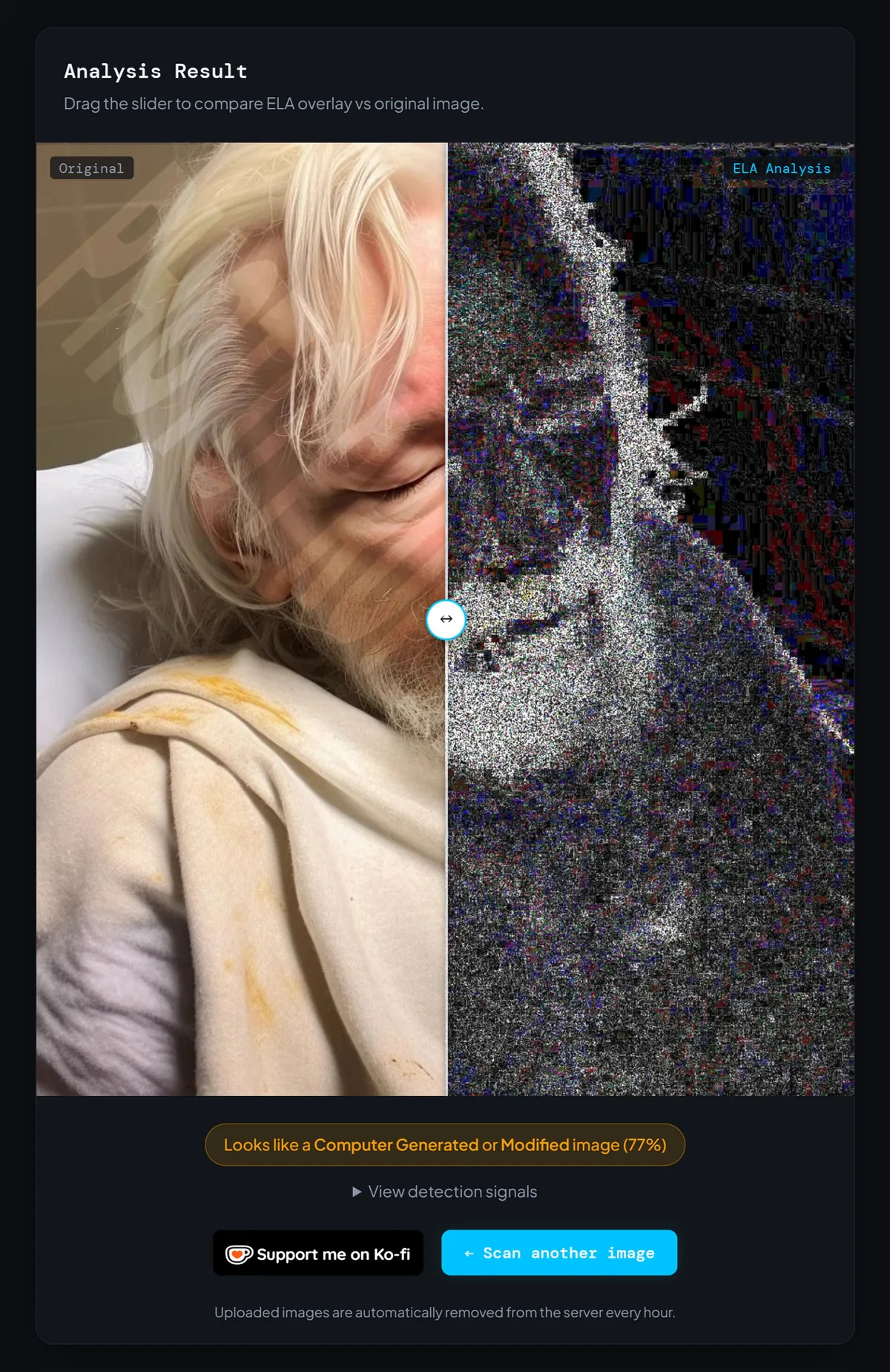
No single one of these is reliable on its own, which is the part vendors tend to gloss over. A pure frequency detector gets fooled by diffusion content it was never trained on. A biological-signal detector is useless on a still image. So serious systems run an ensemble: several specialized models score the same file, and the scores combine into one number with a confidence level. Even then, top tools that hit 90 to 98% on benchmark datasets slip in the messy real world, which is why no honest detector hands you a bare yes or no. It hands you a probability, and you decide what to do with it.
Provenance: The Detection Method That Skips the Pixels
Here is the angle most "how to spot a fake" posts skip entirely. The most reliable long-term fix is not to analyze the image at all, but to check where it came from. Instead of asking "does this look fake," provenance asks "can this file prove it is real."
Two efforts are worth knowing by name. C2PA is an open standard that attaches a tamper-evident record to a file, a sort of nutrition label showing what camera or software made it and how it was edited. Separately, Google's SynthID embeds an invisible watermark into AI-generated content, woven into the pixels so it survives cropping and compression, and Google has said it has marked billions of pieces of content this way. When these signals are present, detection stops being a guessing game. When they are absent, that absence is becoming a soft signal worth noting.
The catch is coverage. Provenance only helps when the tools that made or captured the image chose to sign it, and plenty still do not. Regulation is pushing this along: the EU AI Act's transparency rules for AI-generated content are set to bite in 2026, and various national laws now require labels or traceability. For now, provenance is a strong confirmation when it exists and a quiet question mark when it is missing, but it cannot yet be your only line of defense.
Why Your Own Eyes Aren't Enough Anymore
If there is one number to take from this whole guide, it is this: on average, people are close to guessing when they judge modern fakes. That is not a knock on you. It is the entire point of the technology.
Broader research agrees. A 2024 meta-analysis of 56 studies put average human detection accuracy at about 55%, barely better than a coin flip, and separate figures peg accuracy on high-quality video fakes at roughly 24%. Confidence, meanwhile, stays sky-high: people believe they can spot fake images most of the time. That gap between how good we think we are and how good we actually are is exactly what fraudsters count on. A common mistake I see is someone glancing at an image, feeling certain, and skipping the one step that would have caught it.
The danger isn't that the fakes are perfect. It's that we are overconfident, and scammers price that overconfidence in.
So what do you do with an image you cannot afford to get wrong? Two things, in order. First, run it through a dedicated detector instead of trusting your gut, since a purpose-built image detector like the one on this site reads the frequency and fingerprint signals your eyes cannot. Second, verify the source through a separate channel: if a picture supposedly comes from a person or an account, confirm it another way before you act on it. Detection and verification together beat either one alone.
A Simple Workflow for Checking a Suspicious Image
When something feels off, here is the order I would work through it, fastest checks first.
Get the highest-resolution copy you can, and view it full size. Small, compressed images hide everything.
Scan the danger zones: hands, teeth, ears, jewelry, glasses, eye reflections, and any text in the background.
Check the edges where the face meets hair and neck for smearing or a seam that looks too smooth.
Look for provenance: does the file carry content credentials or a visible source label?
Run it through an image detector and read the confidence score, not just the verdict.
Verify the source independently before you share, believe, or act on it.
Steps one through four take under a minute and will catch the lazy fakes. Steps five and six are what protect you from the good ones. If you never do anything except the last two, you are already ahead of nearly everyone.
Frequently Asked Questions
Can deepfake images be detected with 100% accuracy?
What is the easiest sign of a fake image to check first?
Are AI-generated images and deepfakes the same thing?
How long will manual visual checks keep working?
Where to Go From Here
Deepfake images are not magic, and they are not undetectable. They come from three known engines, they leave signals those engines cannot help producing, and a layered check (your eyes, then software, then the source) still holds up even as the fakes get better. What has changed is that the burden has moved off human perception and onto tools and habits.
Here is your one next step: take an image you are unsure about, right now, and run it through an image detector before you trust it, then build the habit of confirming the source through a second channel. Do that consistently and you will spend the rest of the deepfake era in the small group of people who check, instead of the large group who guess.